

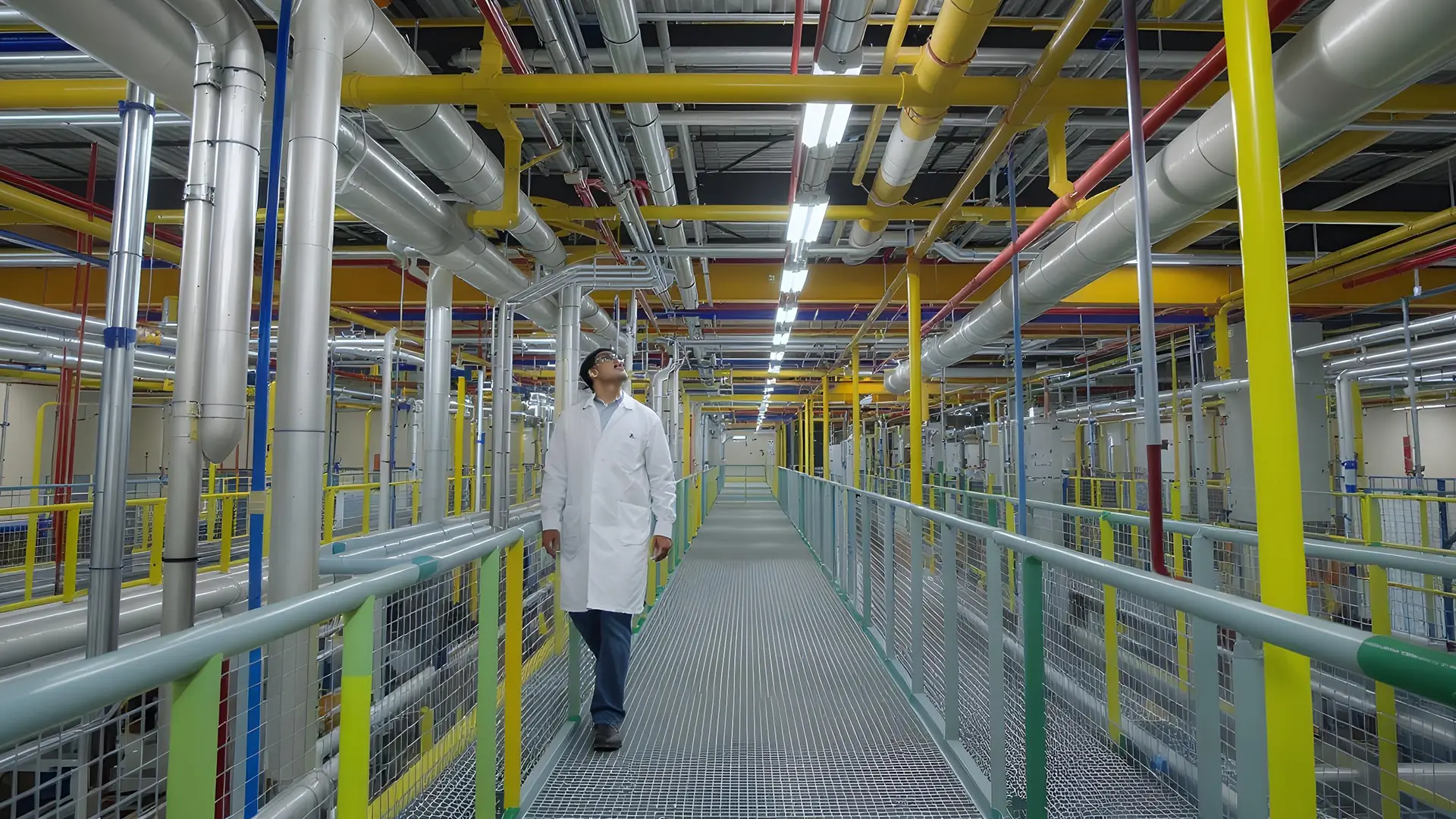
Modern industrial facilities rely on more than structural design and building services. Behind production lines, cleanrooms and advanced manufacturing environments sits a network of process utilities that directly influence performance, stability and operational continuity.
Despite their importance, process utilities are often treated as secondary systems, addressed later in the design process rather than integrated from the start. This approach introduces avoidable risks. In high-tech and industrial environments, process utilities function as core infrastructure and should be designed with the same level of priority as electrical distribution or structural systems.
What are process utilities in modern industrial facilities?
Process utilities are specialised systems that support production processes rather than general building comfort. Unlike conventional mechanical and electrical services, these systems directly interact with manufacturing operations.
Common examples include:
- Clean dry air (CDA) systems
- Process cooling water
- Vacuum systems
- Reverse osmosis or deionised water (RODI)
- Specialised gas distribution
- Process exhaust and environmental control systems
These utilities enable equipment operation, maintain controlled environments and support product quality. When performance deviates, production stability and yield may be affected.
Why process utilities behave like infrastructure
In many facilities, utilities are initially perceived as extensions of building services. However, modern manufacturing environments operate differently from traditional commercial buildings.
Process utilities:
- run continuously regardless of occupancy
- require precise stability rather than comfort-level tolerances
- interact closely with equipment layouts and process flow
- influence energy consumption and system reliability
Because of these characteristics, utilities cannot be added late in design without affecting performance. They shape spatial planning, mechanical capacity, electrical distribution and operational flexibility.
Risks of treating process utilities as secondary systems
When process utilities are introduced too late in the design process, common challenges emerge:
- insufficient space allocation for routing and maintenance access
- conflicts between mechanical, electrical and architectural layouts
- inefficient equipment placement leading to higher energy use
- reduced ability to scale or modify production lines
These issues often appear during construction or commissioning, when changes are more expensive and disruptive.
Early integration reduces coordination risks and improves system performance over the facility lifecycle.
Integration between mechanical, electrical and process systems
Process utilities do not operate in isolation. Their performance depends on coordination across multiple disciplines.
Mechanical systems influence thermal stability and airflow. Electrical systems determine reliability and redundancy. Control systems coordinate operation and monitoring. Equipment layout defines routing paths and accessibility.
Successful projects align these elements during early design stages rather than resolving conflicts later. This approach improves maintainability, reduces rework and supports predictable operational behaviour.
What developers and project teams should consider early
Project teams planning new industrial facilities should evaluate process utilities alongside architectural and structural decisions.
Key considerations include:
- understanding process requirements before finalising layouts
- allocating sufficient space for routing, expansion and maintenance
- defining performance criteria and redundancy expectations
- coordinating utilities with mechanical and electrical strategies from concept stage
Treating utilities as infrastructure ensures that facility design supports long-term performance rather than short-term compliance.
Conclusion
Process utilities form the operational backbone of modern industrial facilities. They are not secondary systems added after building services are defined. Instead, they function as infrastructure that determines whether production environments operate reliably and efficiently.
Designing these systems early, with coordinated mechanical and electrical planning, helps reduce risk, improve maintainability and support stable long-term operation.
H&H First Consultancy approaches process utility design with a focus on integration, reliability and practical engineering clarity. Effective facilities are shaped not only by visible architecture, but by the invisible systems that enable consistent performance.
Modern data center engineering follows similar principles, where infrastructure is designed to maintain operation during failure rather than react to it afterward. This design philosophy extends beyond data centers into industrial facilities, where process utilities form the backbone of operational stability. You may also be interested in our article on how data centers are designed for failure and reliability here.
