

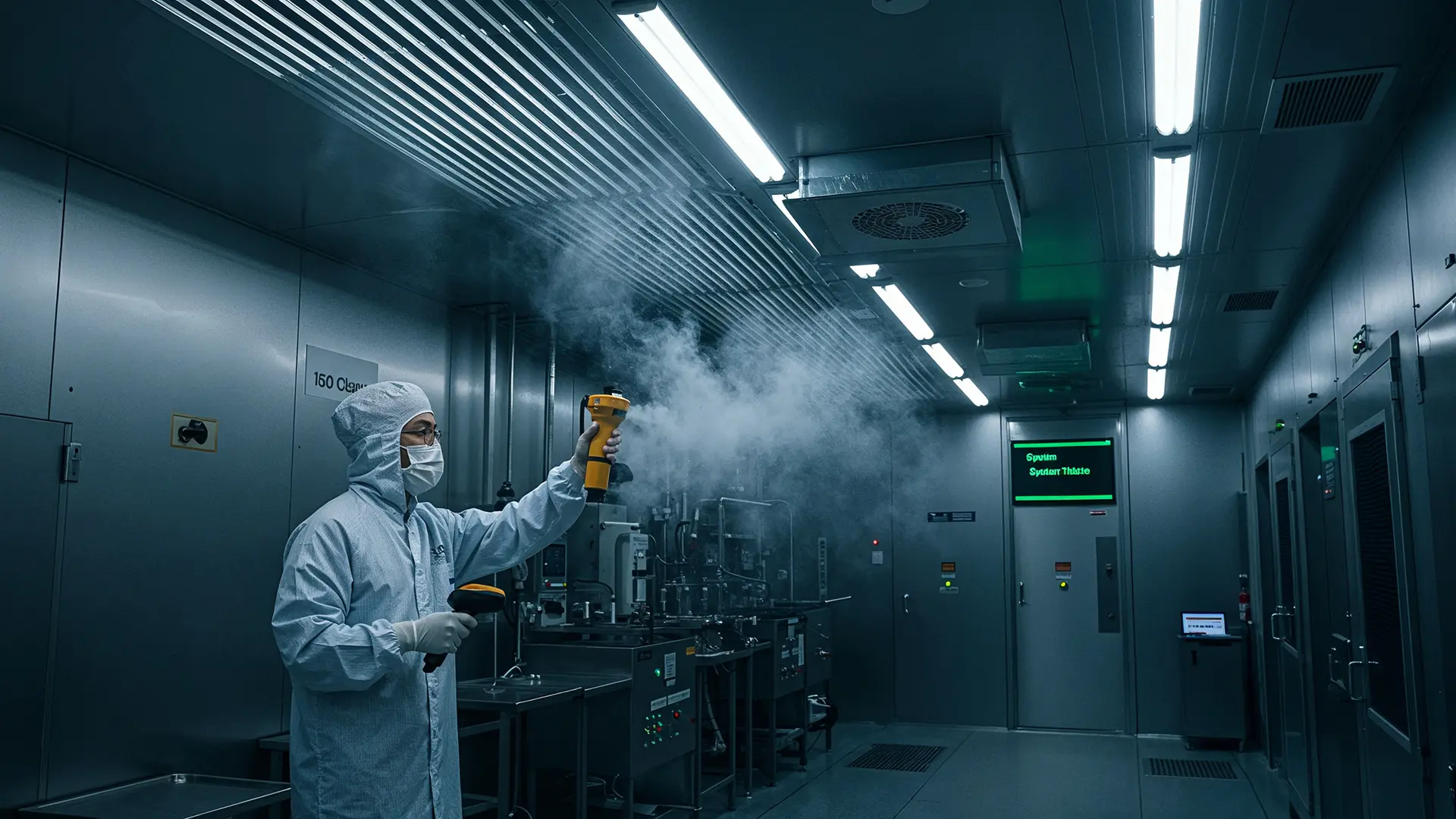
Cleanrooms are often designed to meet specific standards and classifications. Air change rates, particle counts and pressure differentials are defined early and verified during commissioning. These metrics are essential, but compliance alone does not guarantee that a cleanroom will perform consistently over time.
While cleanroom compliance and contamination control are essential, they represent only part of the design challenge. Long-term performance depends on how systems behave together during actual operation.
In practice, cleanrooms that meet requirements on paper can still experience instability during operation if design, integration and operational considerations are not aligned from the start.
This article explains what determines sustained cleanroom performance beyond initial compliance.
What does cleanroom compliance actually cover?
Cleanroom compliance typically focuses on measurable conditions at a specific point in time. This includes:
- airborne particle concentration
- airflow rates and air change effectiveness
- pressure differentials between spaces
- temperature and humidity ranges
These parameters confirm that the cleanroom meets the required classification during testing and commissioning.
However, compliance does not fully address how the cleanroom performs under real operating conditions, where variables such as equipment heat load, personnel movement and process changes come into play.
Why compliant cleanrooms can still underperform
A cleanroom can meet all required standards during validation and still experience performance drift during operation.
Common reasons include:
- airflow patterns disrupted by equipment layout or modifications
- inconsistent pressure relationships between zones
- insufficient coordination between supply and return air paths
- changes in process requirements without corresponding system adjustments
These issues are rarely caused by a single system. They are usually the result of how multiple systems interact over time.
How system integration shapes cleanroom performance
Cleanroom stability depends on coordination between several engineering disciplines.
Airflow design determines how contaminants are controlled and removed. Mechanical systems maintain temperature, humidity and pressure relationships. Process equipment introduces heat loads and influences airflow behaviour. Control systems regulate how these elements respond to changing conditions.
When these systems are designed and coordinated together, the cleanroom can maintain stable performance even as operating conditions vary. When they are treated separately, small inconsistencies can accumulate and affect overall performance.
The role of early design decisions
Many long-term performance issues can be traced back to early design stages.
Decisions related to:
- equipment placement and layout
- air distribution strategy
- return air paths
- zoning and pressure hierarchy
- allowance for future changes
have a direct impact on how the cleanroom behaves during operation.
Addressing these factors early allows the design to accommodate real operating conditions rather than idealised scenarios.
What project teams should consider beyond compliance
For developers, architects and project teams, achieving compliance should be viewed as a starting point rather than the final objective.
Key considerations include:
- how airflow will behave once equipment is installed and operational
- how pressure relationships will be maintained during daily use
- how systems will respond to changes in process requirements
- how easily the cleanroom can be maintained and adjusted over time
These factors determine whether a cleanroom can sustain its required performance throughout its lifecycle.
Conclusion
Cleanroom compliance confirms that a facility meets defined standards at a specific moment. Long-term performance depends on how well systems are integrated, coordinated and adapted to real operating conditions.
Designing for sustained performance requires more than meeting specifications. It requires a clear understanding of how airflow, pressure, equipment and control systems interact over time.
H&H First Consultancy approaches cleanroom design with a focus on integration, coordination and practical engineering clarity. Reliable performance is achieved not only through compliance, but through systems that work consistently under real-world conditions.
